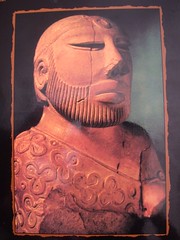
or official; circa 3000 B.C.,
found at Mohenjo-Daro
Stephen Oppenheimer concluded by genetic studies that people moved into India from Africa initially and rest of the world population were descendents of this group. University of Cambridge researchers Michael Petraglia and Hannah James came to the similar conclusion by analyzing fossils, artifacts, and genetic data. So if there was a migration, it was from India to Europe and not the other way. Does this prove that there was no Aryan Invasion/Migration?
While the above migrations happened about 85,000 years back, the theory of Aryan Invasion/Migration talks about what happened around 4000 years back. This is what Dr. Jonathan Mark Kenoyer, who has been excavating in the Indus city of Harappa has to say
The transition from one culture to the next was gradual as seen at Harappa, and there is no evidence for invasions by outside communities such as the so-called Indo-Aryans.
Although some scattered skeletons were discovered in the later levels, they do not represent warfare or raiding, and there is no evidence that the site came to a violent end. [Decline and Transformation]
Now the BBC has updated their page on the history of Hinduism to reflect this. So why are some people still holding onto the invasion theory? A good answer comes from Suhag A Shukla, who was the legal counsel for the Hindu American Foundation in the recent California textbook controversy.
There is no evidence of any invasion or any war. Honestly, the people who have held onto the Aryan invasion theory, probably based their entire careers on that particular theory and have expounded that through their research, they have a vested interest in not seeing it disappear.[‘I am not for rewriting Hinduism’]

I guess this means that we are all related to each other, right?
Btw, I have a copy of the High Priest sitting on my desk, which I bought when I visited Moenjo-Daro last year.
I am glad I discovered your interesting blog today and I will definitely be back often.
People will always cling to obsolete ideas, & theories that are just wrong. It’s a shame, & a disservice to all seekers of our true human legacy; Those now and those to come. Think about the extent that these proponents of the Aryan invasion espouse it. Eventually, the truth banishes all lies, along with those who disseminate it.
So if there was a migration, it was from India to Europe and not the other way.
While I am aware of Oppenheimer’s work, the genetic evidence from both the CFSL and others do not seem to propose a link between Europe and India, the halotypes appear to be quite different. So if there was no large-scale migration into India, there is unlikely to have been any large-scale migration out of India in huge numbers too. Perhaps I missed your conclusion in my reading and I was wondering if you could point me to a reference.
IndianXian, I used that sentence rather loosely. Since people moved from Africa into India and then to rest of the world, it was a casual statement. I have not seen any evidence of this migration in genetic terms.
Quick Intro to Indian history
Do you want to know about Indian history and how European Aryans came to India? Take a look at the SABHA version, assembled from the works of “scholars”. Stanley Wolpert explains lucidly in his book, The New History of India,…
What you have failed to grasp is that the out of africa (and into India and then to Europe, if you like) theory doesn’t preclude an aryan invasion. Historically, human groups have been largely migratory. The first event occured 85,000 years ago. An aryan invasion, as you pointed out, would probably have occured a few thousand years ago. Consider it a homecoming of sorts.
I would be interested to hear your opinion on why north indian languages belong to the indo-european family, while south indian languages belong to the dravidian family? Why are dravidian languages spoken by certain groups in pakistan/afghanistan?
Entire AIT or Aryan migration theory is based on the concept of Indo Euroean Language Family and artificially constructed PIE. This needs to be studiede carefully and should be attacked to give burial to all migration and invasion theories. I hav few points from which I can see that the concept of Indo-European family itself is not correct. Here it is. Let us start working on demolshing this concept as archelogical evidence has buried AIT.
(1) The set of similar words (which are similar words – though in many cases similarity is doubtful) in Sanskrit and other European languages is not very large, is small. I could come across fewer than 100 such words from different sources. Even in that one we can say are very close are quite few, may not be more than couple of dozens (words for mother, father, feet, teeth etc.). This means that there are large numbers of words which are not similar. If one work out numeric measure, I am afraid, it may come out that very small number of words in these languages are similar. Then there is question of HEBREW. One can see that there are large number of words common/similar with HEBREW in European Languages. Similarities are higher than in Sanskrit. Further Sanskrit is supposed to be much older than GREEK or LATIN.
So how can one say that they have common origin?
This means that Sanskrit was developed indepndently from European family and European family had two branches omne of HEBREW and other.
Some words in GREEK and LATIN are borrowed from Sanskrit This scenario is much more likely than common root or clubbing these languages with European languages.
(2) The script Sanskrit and other European languages differ significantly. The scripts of European languages are quite different from script Devnagari of Sanskrit.
(3) The semantic and syntactic differences are significant. Further even in words which are sighted similar there are other related words which are significantly different. E.g. Words for mother and father may be similar, but what about other relations. In Sanskrit there is whole vocabulary (for mother’s brother, father’s brother etc.) which is absent in European Language. Another point is that in Sanskrit other words are used for these, but they do not have common words or remotely similar words (e.g. Anuj is used commonly for brother, but there is no corresponding similar word. This happens in many cases.)
(4) In the same way there many words common (far more than European languages) between Sanskrit and Telugu or Malayalam. Similar is case with Kannada though common words may be smaller. In the same way there are common words between Tamil and Sanskrit. The set of alphabet sounds are same. However this does not mean that South Indian languages originated from Sanskrit. If one applies same logic, it can be said that the origin need not be the same.
(5) In Sanskrit, one does not find any European word, but it is other way round. Words resembling Sanskrit word can be found in European Languages.
(6) I also find that similarity of Sanskrit with other group of languages. Will it not be better to do comparative study and then carry out classification like PIE.
(7) As far as constructing back the old language passages, I found that it is not a very full proof method, as we can create such passages from totally unrelated languages in certain cases. Further it post facto creation, where higher level branch can be created as Super Set
I am no expert. But the Aryan migration theory also rests on the fact that no seals or artifacts depicting horses have been found from the Harappa site. It is proposed that the Aryans were the ones who introduced Horse as a domestic animal.
Also, I am curious to know why ppl in north/south india are from a different racial stock if no foreigners ever came to India.
@swati,
What languages constitute the “dravidian languages” ?