The journey of man animation on the Bradshaw foundation site shows how man reached various continents moving out of Africa starting around 150,000 years back. According to the journey, humans reached India around 85,000 years back and went to Sri Lanka and Indonesia.
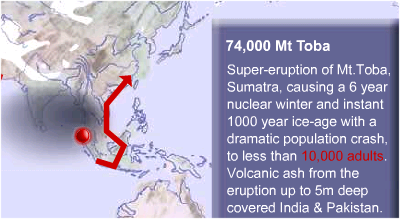
Then, around 74,000 years back, there was an eruption in Toba in Sumatra called the Youngest Toba Tuff (YTT) which resulted in an ice age and volcanic ash covering India. It is believed that the volcanic ash flung into the atmosphere blocked sunlight resulting in a nuclear winter. There was also a population reduction and according to one model, present day humans are descendants of few survivors of the Toba catastrophe.
Investigation of the Toba ash deposited in an Andhra Pradesh village called Jwalapuram in Kurnool district has revealed thatthe blast was not that catastrophic and that some of the hunter gatherers of India survived. Stone blades and other tools as well red ochre used in cave paintings were found both above and below the ash layer indicating that whoever lived at that time survived and there was technological continuity.
These tools were also similar to the ones used to the ones found in Africa around the same time indicating that Indians had closer affinities to African stone age traditions than European ones. It also validates the theory that humans took the route from Africa, through Arabia into India and that India was populated much before Europe. The best evidence to seal the argument would be the discovery of fossil evidence, either human or Neanderthal, but none has been found.

One thought on “Toba Survivors in Andhra Pradesh”